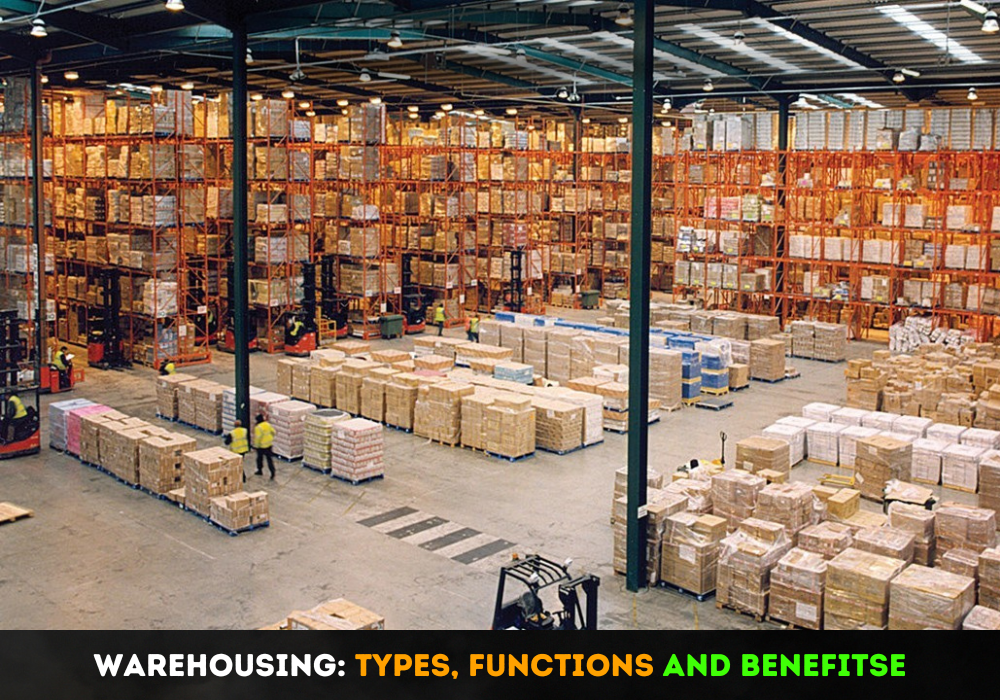
Warehousing is the systematic storage and handling of goods so products remain available and protected until they are required. This function becomes necessary because production, transportation, and customer demand occur at different times and in different locations. By storing goods between these stages, warehousing connects supply with demand, which reduces shortages, limits excess inventory, and supports cost stability.
To connect supply and demand effectively, warehousing operates through a clearly defined and continuous process. Goods enter the warehouse through receiving and inspection, then move into organized storage where inventory is recorded and monitored. From storage, items are retrieved for picking, packed for shipment, and dispatched, and this sequence ensures that inventory accuracy and order consistency are maintained at every stage.
Because this operational sequence can be structured in different ways, warehouses are organized into multiple types. These types include public, private, contract, cooperative, production, distribution, cross-docking, reverse logistics, bonded, and government warehouses. Each type adjusts how storage is controlled, how flexible operations are, how costs are managed, and how quickly goods move through the system.
Through this combination of process and structure, warehousing delivers measurable business benefits. It smooths demand fluctuations, improves service reliability, reduces operational risk, and strengthens cost control. Selecting the right warehouse therefore depends on aligning location, volume, product characteristics, handling needs, technology, labor availability, and cost structure with long-term operational goals.
What is warehousing?
Warehousing is the organized storage and handling of goods within a designated facility to maintain inventory availability and protect product condition before distribution or use. This storage function exists between production, transportation, and consumption, which allows goods to remain accessible while their quantity, location, and condition stay controlled.
What is the purpose of warehousing?
The purpose of warehousing is to align inventory supply with demand by holding goods until they are required. This alignment reduces stock shortages, limits excess inventory, and supports consistent order fulfillment when production and demand occur at different times or locations.
What are the main operations performed in a warehouse?
The main operations performed in a warehouse are the sequential activities that move goods from inbound receipt to outbound dispatch while maintaining inventory accuracy and product condition. These operations are connected, and each operation prepares the ground for the next one.
- Receiving: Receiving is the entry of goods into the warehouse, where shipments are unloaded, counted, and matched against purchase or transfer documents to confirm quantity and identity.
- Inspection and quality checking: Inspection verifies product condition and compliance with specifications, which prevents damaged, incorrect, or non-compliant goods from entering active inventory.
- Put-away: Put-away is the movement of accepted goods to assigned storage locations based on slotting rules, product characteristics, and space optimization logic.
- Storage: Storage holds goods in organized locations using racks, bins, or floor space, which preserves product condition and enables controlled access until demand arises.
- Inventory control: Inventory control tracks stock levels, locations, and movements through records and counting methods, which keeps inventory data aligned with physical stock.
- Order picking: Order picking retrieves specific items from storage to fulfill customer or internal orders, and accuracy at this stage directly affects service quality.
- Packing: Packing prepares picked items for shipment by consolidating, protecting, and labeling goods according to handling and transport requirements.
- Shipping and dispatch: Shipping releases packed orders from the warehouse, coordinates loading, and hands goods to transport, which completes the outbound flow.
Together, these operations form a continuous warehouse process that supports accuracy, efficiency, and reliable order fulfillment without breaking inventory flow.
Why is warehousing important for businesses?
Warehousing is important for businesses because it stabilizes inventory availability while controlling logistics costs and service performance. By holding goods closer to demand points, warehousing reduces delivery delays, supports faster order processing, lowers damage risk through controlled handling, and improves inventory visibility for purchasing and replenishment decisions.
What types of warehouses exist?
The types of warehouses are defined by how storage is owned, how inventory is used, and how goods move through the facility. This classification exists because storage needs change depending on control requirements, operational purpose, and inventory flow speed. Each warehouse type reflects a specific way of organizing the same core storage function.
- Public warehouses: Public warehouses store goods for multiple businesses within shared facilities. This shared structure reduces fixed storage costs and allows flexible, short-term space usage.
- Private warehouses: Private warehouses are operated by a single organization. This structure provides full control over storage layout, inventory systems, and operating procedures.
- Contract warehouses: Contract warehouses operate under long-term service agreements. This model combines dedicated storage with outsourced management, which balances control and cost predictability.
- Cooperative warehouses: Cooperative warehouses are jointly owned by member organizations. This arrangement spreads storage costs while maintaining shared operational control among participants.
- Production or manufacturing warehouses: Production warehouses store raw materials, components, and work-in-progress near manufacturing sites. This proximity supports continuous production and reduces internal movement delays.
- Distribution centers: Distribution centers focus on rapid order fulfillment rather than long-term storage. Their layout prioritizes picking, packing, and outbound dispatch to support fast delivery.
- Cross-docking warehouses: Cross-docking warehouses transfer goods directly from inbound receiving to outbound shipping. This process minimizes storage time and reduces inventory holding.
- Reverse logistics warehouses: Reverse logistics warehouses handle returned, damaged, or excess goods. These facilities support inspection, sorting, recovery, or disposal activities.
- Bonded warehouses: Bonded warehouses store imported goods under customs supervision. This structure allows duties to be deferred until goods enter domestic circulation.
- Government warehouses: Government warehouses store regulated, strategic, or relief supplies. These facilities support public distribution, policy enforcement, and emergency response.
These warehouse types represent structured variations of the same storage function, each designed to match specific control needs, inventory behavior, and operational objectives.
Public Warehouses
Public warehouses provide storage capacity by allowing multiple businesses to place goods within a shared facility managed by a third party. This arrangement exists to accommodate changing storage needs without long-term commitments. Space allocation, handling methods, and labor resources follow standardized systems, which makes access fast and scalable. As a result, businesses avoid upfront investment and gain short-notice storage. The trade-off appears in limited layout control and restricted process customization. Public warehouses therefore suit temporary inventory holding, seasonal stock buildup, and excess capacity management. In summary, they serve variable demand environments where flexibility matters most.
Private Warehouses
Private warehouses support storage operations through facilities controlled entirely by one organization. This setup exists to align storage activities directly with internal supply chain requirements. Facility design, material handling equipment, and workforce practices are configured around specific products and service targets. This configuration strengthens handling accuracy and operational predictability. However, facility ownership increases fixed expenses and reduces cost flexibility during demand shifts. Private warehouses fit businesses with consistent throughput and long-term inventory planning. Overall, they favor stability and precision over adaptable capacity.
Contract Warehouses
Contract warehouses deliver warehousing services through negotiated agreements that define responsibilities, performance levels, and cost terms. This model exists to provide tailored operations while keeping facility ownership external. Storage processes, reporting methods, and service standards are adjusted to client requirements within the contract scope. This structure supports expansion without capital expenditure. The limitation lies in contractual rigidity, which restricts rapid operational change. Contract warehouses suit organizations transitioning between growth stages. In essence, they offer customized operations within predefined service boundaries.
Cooperative Warehouses
Cooperative warehouses operate through collective ownership, where several independent organizations jointly maintain a single storage facility. The objective is to spread infrastructure and operating expenses across members who face similar storage demands. Governance relies on shared policies that regulate space usage, inventory handling, and financial contributions. This arrangement improves affordability and access to larger facilities. The compromise appears in slower decision cycles and reduced individual authority. Cooperative warehouses are best suited for agricultural collectives, producer unions, and small enterprises. In summary, they prioritize shared efficiency through coordinated participation rather than individual control.
Production / Manufacturing Warehouses
Production or manufacturing warehouses function as material-holding points directly linked to factory operations. Their role is to position inputs and in-process items near production zones so manufacturing activity remains uninterrupted. Storage design emphasizes immediate material availability, frequent internal transfers, and alignment with production sequencing. This setup minimizes downtime and internal transport effort. The drawback is limited usefulness for customer-facing distribution. These warehouses suit plants with structured output plans. Overall, they serve as internal logistics anchors that stabilize manufacturing workflows.
Distribution Centers
Distribution centers are logistics facilities designed to accelerate outbound order movement instead of supporting prolonged storage. Their role is to stage inventory near end markets so customer delivery times decrease. Operational focus centers on rapid order assembly, shipment coordination, and continuous dispatch cycles. This operating model enhances responsiveness and throughput. The trade-off is increased system dependence and higher operating intensity. Distribution centers fit high-velocity retail and e-commerce environments. In effect, they act as transfer nodes that emphasize speed and execution over storage duration.
Cross-Docking Warehouses
Cross-docking warehouses function as short-stay transit points where shipments pass through without being placed into storage. Their objective is to move goods across the facility as quickly as possible once they arrive. Operations revolve around dock coordination, real-time scheduling, and immediate sorting. This design minimizes storage dependency and reduces inventory holding costs. The drawback is sensitivity to delays, since timing errors disrupt the entire flow. Cross-docking suits perishable goods, retail replenishment, and high-velocity freight. In effect, these facilities prioritize movement accuracy over storage capacity.
Reverse Logistics Warehouses
Reverse logistics warehouses are designed to manage goods that travel backward through supply networks after delivery or use. Their purpose is to control return flows by separating reusable, repairable, and disposable items. Processing focuses on evaluation, segregation, refurbishment, and disposal pathways. This setup supports value recovery and compliance handling. Challenges arise from inconsistent return volumes and unpredictable item conditions. Reverse logistics warehouses fit sectors with frequent product returns, such as consumer electronics and apparel. Overall, they act as structured recovery hubs rather than forward distribution points.
Bonded Warehouses
Bonded warehouses provide secured storage for imported goods that remain under customs authority until clearance decisions occur. Their role is to hold inventory while postponing duty payment or preparing goods for re-export. Facility management emphasizes controlled access, audit trails, and regulatory documentation. This structure improves cash management and trade flexibility. The limitation lies in administrative complexity and strict compliance oversight. Bonded warehouses serve importers, exporters, and international trading firms. In summary, they operate as compliance-driven storage environments within cross-border supply chains.
Government Warehouses
Government warehouses support public systems by holding goods reserved for national programs and emergency response. Their purpose is long-term availability rather than commercial circulation. Stored materials often include food stocks, medical reserves, and disaster relief supplies. Operations prioritize security, inventory accountability, and controlled release procedures. These priorities reduce responsiveness and private access. Government warehouses suit public distribution schemes and crisis preparedness planning. Ultimately, they function as safeguard facilities designed to maintain supply stability during critical situations.
How is inventory managed in a warehouse?
Inventory is managed in a warehouse by recording, tracking, and updating stock as it moves through each operational stage. Management starts when goods are received and identified, continues as items are assigned to specific storage locations, and remains active through picking and dispatch. Because each movement updates inventory records, physical stock and system data stay aligned, which reduces discrepancies and supports accurate replenishment planning.
How do warehouses ensure the security of stored goods?
Warehouses ensure the security of stored goods by controlling access, monitoring movement, and regulating handling procedures. Security begins at entry points, extends through restricted storage zones, and is reinforced by tracking who handles goods and when movement occurs. As these controls work together, unauthorized access decreases and the risk of loss or damage remains contained.
How do businesses manage warehouse layout and storage space?
Businesses manage warehouse layout and storage space by arranging areas to support efficient product flow and safe movement. Planning starts by separating receiving, storage, picking, and shipping zones, then places products according to size, turnover rate, and handling needs. This structured layout shortens travel distance, improves picking speed, and prevents congestion during daily operations.
What are the key benefits of warehousing for businesses?
The key benefits of warehousing for businesses come from how structured storage supports inventory stability, operational coordination, and service reliability across the supply chain. Each benefit builds on the previous one, forming a connected system rather than isolated advantages.
- Inventory continuity: Warehousing maintains product availability between production and consumption, which prevents supply interruptions when demand timing changes.
- Demand stabilization: Stored inventory absorbs fluctuations in customer demand, which separates production schedules from consumption patterns.
- Fulfillment accuracy: Centralized storage improves order picking and handling consistency, which reduces shipment errors.
- Cost management: Planned storage lowers reliance on urgent transportation and emergency handling, which stabilizes logistics expenses.
- Risk containment: Controlled storage environments reduce loss, damage, and deterioration caused by uncontrolled handling.
- Operational scalability: Warehousing supports volume growth by accommodating higher throughput without disrupting existing distribution processes.
Together, these benefits show how warehousing acts as a control layer that connects inventory availability, cost stability, and service performance into a single operational system.
What are the disadvantages of warehousing?
The disadvantages of warehousing result from the financial, operational, and inventory risks created when goods are held over time. These drawbacks emerge as a direct consequence of storing inventory rather than moving it immediately.
- Operating cost exposure: Facilities, labor, utilities, and equipment create ongoing expenses that increase total logistics costs.
- Inventory value risk: Extended storage increases the likelihood of obsolescence, spoilage, or depreciation, especially for time-sensitive goods.
- Capital commitment: Owned or long-term leased warehouses tie up financial resources that could otherwise support growth or flexibility.
- Operational complexity: Managing layout, labor scheduling, and inventory systems adds administrative and coordination effort.
- Forecast dependency: Inaccurate demand planning leads to excess stock or insufficient availability, which reduces efficiency.
These disadvantages highlight the need to balance storage benefits against cost, complexity, and inventory risk so warehousing strengthens operations rather than weakens them.
What factors should be considered when choosing a warehouse?
The factors to consider when choosing a warehouse determine how effectively the facility supports inventory movement, cost control, and service reliability across daily operations. Each factor connects to the next because warehouse performance depends on how physical location, capacity, and operations work together rather than in isolation.
- Location alignment: Distance to suppliers, customers, and transport routes directly affects delivery time, freight cost, and service responsiveness.
- Space adequacy and growth capacity: Available storage and handling capacity must support current inventory levels while allowing expansion without disruption.
- Product and handling fit: Storage conditions, equipment, and compliance requirements must match product size, value, and sensitivity.
- Operational design efficiency: Layout, workflow, technology, and labor access determine handling speed, accuracy, and congestion risk.
- Total cost structure: Fixed and variable costs must align with inventory turnover and long-term budget sustainability.
Choosing a warehouse requires aligning location, capacity, product needs, operational design, and cost structure so storage supports performance rather than creating friction.
How much does warehousing typically cost for businesses?
Warehousing typically costs businesses between 15% and 30% of the average inventory value per year, because storage involves more than space alone. This range includes facility expenses, labor, utilities, equipment use, inventory handling, and administrative control, with total cost varying based on warehouse type, service level, location, and product characteristics.
What are the best practices for moving items into a warehouse?
The best practices for moving items into a warehouse focus on controlled preparation, coordinated handling, and accurate intake. The process begins before arrival by scheduling deliveries to match receiving capacity, which prevents congestion and delays. Once items arrive, clear labeling and complete documentation guide unloading and inspection. After verification, goods are moved using suitable handling equipment and placed into assigned storage locations. This ordered sequence keeps inventory records aligned with physical stock, reduces damage risk, and establishes accuracy from the first point of entry.
Who is a reliable mover in Bristol for transporting items to a warehouse?
A reliable mover in Bristol for transporting items to a warehouse is MO Transport, where we manage warehouse moves through planned and consistent handling. We coordinate collection times, loading order, and transport routes so goods arrive in a condition that supports efficient receiving. Our process emphasizes secure loading, controlled transit, and timely delivery, which allows warehouse teams to continue intake without disruption. By maintaining structure at each stage, we support smooth transfer from transport to storage.