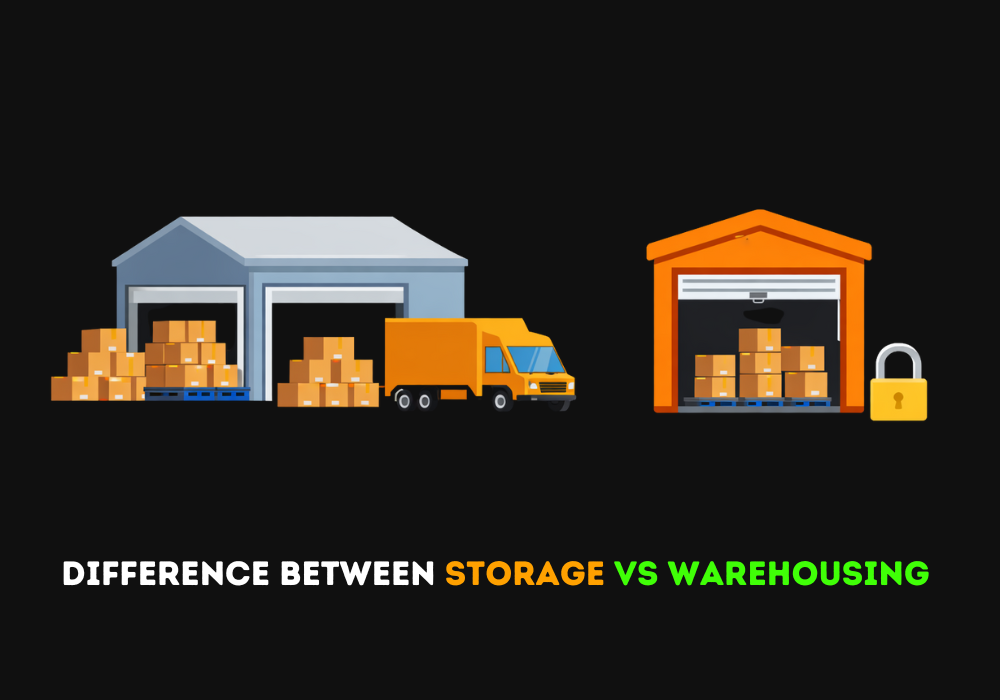
Storage and warehousing are inventory-holding systems that are different in purpose, operational depth, and role within the supply chain. Storage means placing goods in a designated physical space to preserve them for later use, where movement is infrequent and handling activity remains low, which keeps inventory largely static over time. Warehousing extends this function by managing inventory as it moves, adding structured processes such as receiving, tracking, handling, and preparing goods for distribution, which turns stored goods into active supply chain assets. This relationship explains the core difference between the two, because storage focuses on space utilization and cost containment, while warehousing focuses on inventory control, coordination, and flow. These functional priorities shape their strengths and limits, as storage provides flexibility, lower operating costs, and simple management but offers no fulfillment capability or systematic tracking, whereas warehousing delivers inventory visibility, scalability, faster order execution, and supply chain integration while requiring higher investment and operational oversight. The correct choice follows inventory behavior, since storage aligns with low turnover, infrequent access, surplus stock, or idle goods, while warehousing aligns with high turnover, regular order cycles, SKU complexity, and distribution-driven operations. Matching storage to static inventory preserves efficiency, matching warehousing to moving inventory supports continuity, and aligning each option with its operational role maintains clarity, cost balance, and supply chain stability without forcing readers to shift their understanding while reading.
What is storage?
Storage is the act of holding goods in a designated physical space for preservation and later access without active inventory management. In storage (storage unit), goods remain largely static, movement is infrequent, and handling is limited to placement and retrieval, which means the primary function is space allocation rather than operational processing. This structure makes storage suitable for inventory that does not require tracking, fulfillment, or regular circulation, such as surplus stock, seasonal goods, equipment, documents, or personal items. Because storage excludes systematic control and distribution functions, it operates with lower complexity and lower cost, aligning its role with inventory stability rather than inventory flow.
What is warehousing?
Warehousing is the organized management of goods within a facility where inventory is actively controlled, handled, and prepared for distribution. Unlike storage, warehousing treats inventory as a moving asset, which requires receiving processes, location assignment, tracking, and outbound preparation to support order fulfillment. These functions connect warehousing directly to supply chain operations, because inventory movement, accuracy, and timing affect downstream distribution performance. As a result, warehousing supports businesses with frequent inventory turnover, multiple SKUs, and ongoing order activity, positioning it as an operational system rather than a space-only solution.
What are the key differences between storage and warehousing?
The difference between storage and warehousing is defined by the level of inventory activity and operational involvement. Storage exists to hold goods in a fixed space where movement is limited and handling occurs only during placement or retrieval, which keeps inventory inactive over time. Warehousing expands this role by managing inventory through structured processes that support movement, control, and distribution, which makes inventory an operational asset rather than a static resource. This distinction affects how goods are handled, tracked, and integrated into business operations, creating clear functional separation between the two systems.
| Feature / Attribute | Storage | Warehousing |
| Operational purpose | Space holding | Inventory management |
| Inventory movement | Minimal | Continuous |
| Handling scope | Placement and retrieval | Receiving, picking, packing, shipping |
| Inventory tracking | Absent or manual | Systematic and digital |
| Fulfillment capability | Not included | Central function |
| Cost structure | Lower and fixed | Higher and activity-based |
| Supply chain role | Isolated | Integrated |
These differences show that storage stabilizes inventory, while warehousing enables inventory flow across the supply chain.
Why do businesses use storage and warehousing?
Businesses use storage and warehousing to manage inventory based on cost, movement, and operational needs. Storage allows businesses to hold surplus, seasonal, or inactive inventory without engaging in complex processes, which helps control space constraints and reduce overhead. Warehousing allows businesses to manage inventory that must move regularly by coordinating receiving, tracking, and distribution, which improves order accuracy and delivery performance. Together, storage and warehousing support inventory continuity by matching inventory behavior with the appropriate level of operational control.
What are the core functions of a warehouse?
A warehouse performs coordinated functions that transform inventory from stored goods into distributable units. These functions begin with receiving inbound inventory and verifying quantities, which establishes accuracy at entry. Inventory is then assigned locations and stored in a structured layout to support accessibility and space efficiency, followed by tracking activities that maintain real-time visibility. Warehouses further execute picking and packing processes to prepare orders and outbound shipping processes to move goods to the next supply chain stage, which connects warehouse operations directly to distribution performance.
How do storage and warehousing support supply chain efficiency?
Storage and warehousing support supply chain efficiency by controlling inventory placement, timing, and movement across supply chain stages. Storage stabilizes inventory by holding goods close to demand or production points, which reduces supply disruption and buffers variability, while warehousing manages inventory movement through structured handling and coordination, which aligns inbound and outbound flows. Acting together as central inventory hubs, they reduce unnecessary transportation, shorten lead times, and improve planning accuracy by consolidating inventory and processes in controlled locations. Storage and warehousing improve supply chain efficiency through the following connected functions.
- Inventory buffering: Holding surplus inventory absorbs demand fluctuations and prevents stockouts during demand spikes.
- Transportation consolidation: Centralized inventory reduces shipment frequency and lowers per-unit transportation costs.
- Inventory visibility: Warehousing systems track stock levels and locations, which improves replenishment accuracy and planning.
- Lead time reduction: Stored inventory positioned near distribution points shortens order fulfillment cycles.
- Handling efficiency: Structured layouts and standardized workflows reduce handling time and labor inefficiencies.
- Error reduction: Controlled processes lower the risk of damage, misplacement, and picking errors.
- Demand alignment: Aggregated inventory data supports forecasting and production planning decisions.
- Flow coordination: Warehousing synchronizes inbound supply with outbound demand, maintaining continuity across the supply chain.
By combining inventory stability from storage with inventory movement from warehousing, supply chains achieve lower costs, higher reliability, and predictable operational flow.
What are the main types of storage facilities?
There are seven different types of storage facilities, categorized by access method, environmental control, and usage context. Each type exists to match specific storage conditions, ensuring that goods remain secure, accessible, and preserved according to their physical and operational requirements.
- Indoor Storage: Enclosed spaces designed to protect goods from weather exposure and unauthorized access, supporting long-term holding of household or boxed items.
- Outdoor and Drive-Up Storage: Ground-level units with direct vehicle access, enabling frequent loading and unloading of large or heavy goods.
- Climate-Controlled Storage: Regulated environments that maintain stable temperature and humidity levels, preventing damage to sensitive materials.
- Portable and Mobile Storage: Transportable units placed on-site to support temporary storage during relocation, renovation, or short-term projects.
- Vehicle Storage: Dedicated spaces for storing cars, boats, or recreational vehicles, focused on secure and stationary holding.
- Business Storage: Storage units used to hold surplus inventory, tools, or records outside active workspaces.
- Specialty Storage: Purpose-specific facilities designed for items requiring unique conditions, such as hazardous materials or valuable assets.
Together, these storage facility types form a structured system that aligns storage space, access level, and environmental control with the physical nature and usage pattern of stored goods.
What are the different types of warehouses?
There are seven different types of warehouses, defined by ownership model, regulatory status, and storage conditions. This classification explains how inventory is controlled, who operates the facility, and what type of goods the warehouse is designed to handle.
- Third-party logistics (3PL) warehouse: Facilities operated by external providers that manage storage and distribution for multiple businesses.
- Public warehouse: Commercial warehouses that offer rentable storage space and basic services to different clients.
- Private warehouse: Company-owned facilities used exclusively to store and manage internal inventory.
- Government warehouse: State-controlled facilities used for public supply, regulation, or strategic reserves.
- Cooperative warehouse: Shared warehouses owned and used jointly by member organizations.
- Bonded warehouse: Customs-approved facilities that hold imported goods before duty payment or clearance.
- Refrigerated warehousing: Temperature-controlled warehouses designed for perishable or sensitive goods.
Together, these warehouse types align inventory management with ownership control, legal requirements, and product handling needs, ensuring goods are stored and managed under appropriate operational conditions.
What are the benefits and limitations of storage?
The benefits and limitations of storage arise from its role as a space-focused system designed to hold inventory without active operational processing. Because storage centers on keeping goods stationary, its advantages relate to simplicity, control, and cost efficiency, while its limitations emerge when inventory requires movement, coordination, or system-level management.
1. Benefits of Storage
- More flexibility: Storage allows variable rental terms and access schedules, which supports both short-term and long-term holding needs.
- Improved security: Controlled access and physical safeguards reduce unauthorized handling and inventory loss.
- Better organization: Dedicated storage space enables orderly placement of goods, which minimizes damage and misplacement.
- Effective cost management: Lower fixed costs and limited service requirements reduce ongoing operational expenses.
- Low operational involvement: Minimal handling and process requirements simplify oversight and resource allocation.
2. Limitations of Storage
- Lack of inventory visibility: Storage does not provide systematic tracking or real-time inventory data.
- No fulfillment capability: Storage excludes picking, packing, and shipping functions.
- Reduced scalability: Storage efficiency declines as inventory volume and movement increase.
- Manual handling reliance: Placement and retrieval depend largely on manual effort.
- Operational isolation Storage functions separately from logistics and distribution systems.
As a result, storage performs effectively when inventory remains static and cost control is the priority, but it loses effectiveness as operational complexity and inventory movement increase.
What are the benefits and limitations of warehousing?
The benefits and limitations of warehousing stem from its function as a system that actively manages inventory movement, control, and distribution. Because warehousing treats inventory as a moving operational resource, it creates efficiency and accuracy through structured processes, while introducing cost and complexity as direct consequences of that structure.
1. Benefits of Warehousing
- Inventory accuracy: Controlled receiving, tracking, and handling reduce stock discrepancies and data errors.
- Order processing speed: Defined picking, packing, and dispatch workflows shorten fulfillment cycles.
- Scalable operations: Standardized processes support higher inventory volumes and order frequency.
- Supply chain continuity: Warehousing links inbound supply with outbound distribution without interruption.
- Process control: Measurable workflows improve consistency, accountability, and performance monitoring.
2. Limitations of Warehousing
- Higher operating cost: Labor, systems, and infrastructure increase total inventory expenses.
- Process complexity: Coordinated workflows require skilled management and oversight.
- System reliance: Technology failures directly disrupt inventory control and fulfillment.
- Reduced flexibility: Standardized processes limit adaptability for irregular inventory patterns.
- Implementation effort – Setup and integration demand time, configuration, and organizational alignment.
Warehousing improves inventory movement and control through structured operations, but the same structure increases cost and complexity, making effectiveness dependent on inventory scale and activity level.
How do storage and warehousing differ in operations and inventory handling?
Storage and warehousing differ in operations and inventory handling by the level of activity applied to inventory. Storage operations involve placing goods into a designated space and retrieving them when required, which limits handling to entry and exit and keeps inventory static for most of its holding period. Warehousing operations extend this basic holding function by continuously managing inventory through receiving, location assignment, tracking, picking, packing, and dispatch, which keeps inventory in controlled motion. Because of this operational expansion, inventory handling in storage relies on manual identification and limited oversight, while inventory handling in warehousing relies on structured workflows, defined handling sequences, and system-based visibility. This difference explains why storage supports preservation and space efficiency, whereas warehousing supports accuracy, speed, and coordinated distribution.
What is a warehouse management system (WMS)?
A warehouse management system (WMS) is software that controls and coordinates warehouse operations by linking physical inventory movement with digital records. It manages receiving, storage location assignment, inventory tracking, picking, packing, and shipping within a single operational framework, which maintains consistency across all warehouse activities. By synchronizing inventory data with handling processes, a WMS reduces errors, improves order accuracy, and enables efficient use of space and labor.
How are storage and warehousing costs calculated?
Storage and warehousing costs are calculated based on how inventory occupies space and how frequently inventory is handled. Storage costs depend mainly on unit size, storage duration, and access level, which results in fixed and predictable pricing tied to space usage. Warehousing costs depend on activity-based components such as pallet positions, inventory volume, handling frequency, labor effort, and value-added services, which causes pricing to fluctuate with operational intensity. This cost structure reflects functional purpose, because storage pricing aligns with holding inventory, while warehousing pricing aligns with managing inventory movement.
What factors influence storage and warehousing pricing?
Storage and warehousing pricing is determined by how inventory consumes space, requires handling, and uses operational resources. These pricing outcomes reflect both physical constraints, such as occupied area, and operational demands, such as labor, systems, and service intensity, which together define the total cost of holding and managing inventory.
- Space utilization: Pricing increases as inventory occupies more square footage, pallet positions, or cubic capacity, because space directly limits facility throughput.
- Facility location: Warehouses and storage units in high-demand or urban regions carry higher rates due to land value, labor cost, and regulatory overhead.
- Duration of storage: Longer storage periods often reduce per-unit cost, while short-term or flexible arrangements increase pricing due to turnover inefficiency.
- Handling frequency: Each inventory movement, including receiving, relocation, or retrieval, adds labor and equipment cost, raising overall pricing.
- Service complexity: Additional services such as climate control, inventory tracking, picking, packing, or compliance handling increase cost due to higher operational input.
Together, these factors explain why pricing varies not only by space but also by how actively inventory is managed.
How do storage and warehousing costs compare?
Storage costs are lower and more stable than warehousing costs because they are driven primarily by space occupancy rather than operational activity. Storage pricing usually follows fixed monthly rates based on unit size and rental duration, which creates predictable expenses. Warehousing costs fluctuate because they depend on variable factors such as inventory volume, handling frequency, labor involvement, and value-added services, causing costs to scale with inventory movement rather than remaining constant.
When is storage more suitable than warehousing?
Storage is more suitable when inventory remains inactive and does not require operational processing. This situation applies to surplus stock, seasonal inventory held outside selling periods, archived records, equipment, or personal goods, where access is occasional and distribution is not required. In these cases, storage minimizes cost while still providing security and space efficiency, making additional operational services unnecessary.
When is warehousing more suitable than storage?
Warehousing is more suitable when inventory supports ongoing sales, distribution, or production activity. This includes environments where inventory turnover is high, order fulfillment is continuous, and delivery speed affects business performance. Warehousing provides the structured handling, tracking, and coordination required to maintain accuracy and flow in these conditions, which storage alone cannot support.
When should a business move from simple storage to warehousing?
A business should move from storage to warehousing when inventory behavior shifts from static holding to active circulation. This transition typically occurs as order volume increases, SKU variety expands, and customer fulfillment becomes a core operational function. At this stage, the lack of visibility, coordination, and processing in storage creates inefficiencies, while warehousing offsets higher cost with improved control, speed, and scalability.
How to choose the right type of storage or warehouse?
Choosing the right type of storage or warehouse depends on how inventory is used, how often it moves, and how closely it connects to daily operations. This choice begins by understanding whether inventory remains static or circulates regularly, because static inventory aligns with space-focused solutions while circulating inventory requires process-driven environments.
- Inventory volume: Higher volumes increase space pressure, which favors structured facilities over basic storage units.
- Inventory turnover: Low turnover supports storage, while frequent turnover requires warehousing to maintain flow control.
- Handling intensity: Minimal handling aligns with storage, while repeated handling aligns with warehousing operations.
- Access frequency: Occasional access supports storage, while continuous access supports warehouse-based workflows.
- Cost structure tolerance: Fixed and predictable costs favor storage, while variable, activity-based costs favor warehousing.
- Location dependency: Inventory positioned near customers or suppliers often benefits from warehouse infrastructure.
- Process visibility needs: Inventory that requires tracking, accuracy, and coordination depends on warehousing systems.
- Growth trajectory: Anticipated increases in volume or orders favor warehousing to prevent future operational constraints.
Evaluating these factors together ensures the selected solution matches inventory behavior today while remaining viable as operational demands change.
What factors should be considered before selecting a warehousing solution?
Selecting a warehousing solution requires confirming that the facility can support inventory movement without creating cost or process friction. This evaluation focuses on whether the warehouse structure aligns with product handling needs, order activity, and system integration.
- Product characteristics: Size, weight, and sensitivity determine storage layout and handling requirements.
- Order frequency: Frequent orders require efficient picking and dispatch workflows.
- System compatibility: Integration with inventory and order systems ensures accuracy and continuity.
- Service requirements: Required functions such as picking, packing, or returns handling affect operational fit.
- Cost sustainability: Activity-based pricing must remain proportional to inventory movement and revenue.
Considering these factors together ensures the warehousing solution supports inventory flow, cost control, and operational stability without introducing inefficiency.
How do industry requirements affect storage and warehousing needs?
Industry requirements affect storage and warehousing needs by defining handling standards, regulatory constraints, and operational complexity. Industries such as food, pharmaceuticals, and chemicals require controlled environments, compliance monitoring, and traceability, which increases the need for specialized warehousing rather than basic storage. Retail and eCommerce industries emphasize speed, accuracy, and order volume, which drives demand for warehouses with structured workflows and fulfillment capabilities. In contrast, industries with low turnover or long holding periods prioritize secure storage space over active inventory management, making storage more suitable than warehousing.
How does technology impact storage and warehousing efficiency?
Technology impacts storage and warehousing efficiency by improving visibility, accuracy, and process speed. Inventory tracking systems, automation tools, and barcode or RFID scanning reduce manual handling errors and shorten processing time. In warehousing, technology coordinates inventory movement and labor allocation, which increases throughput and space utilization, while in storage it improves access control and basic inventory awareness without adding operational complexity.
How are storage and warehousing evolving to meet future demand?
Storage and warehousing are evolving by adopting automation, data-driven planning, and flexible facility design. Growing demand volatility and faster delivery expectations push warehouses toward robotics, real-time analytics, and scalable layouts that adjust to changing inventory patterns. Storage facilities evolve by offering modular space, improved security systems, and limited technology integration to support flexibility without transforming into full operational hubs.