
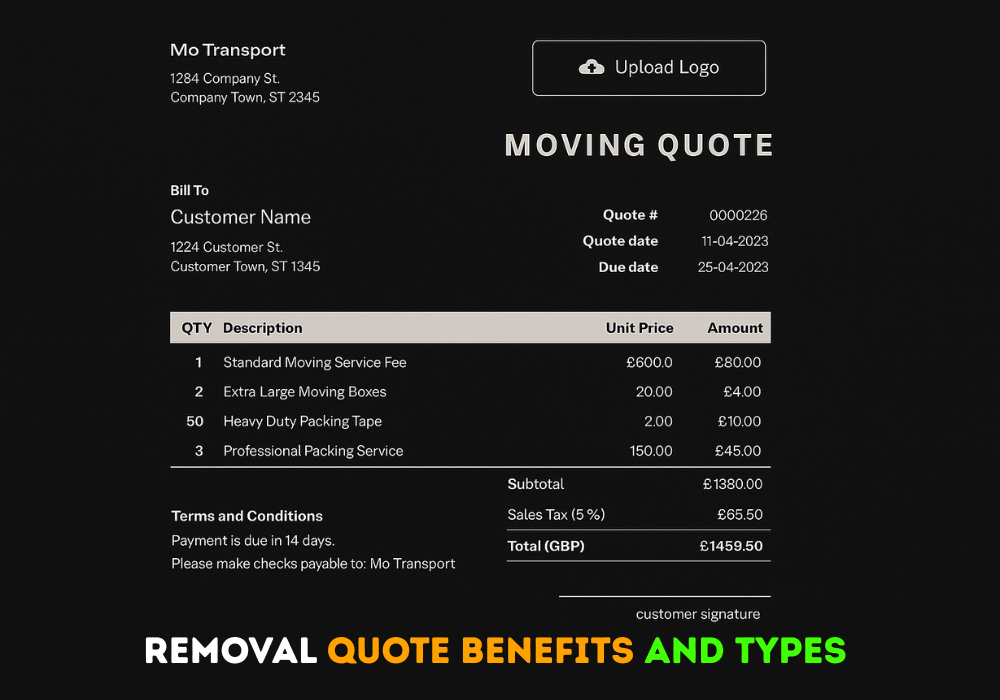
A removal quote is a detailed cost estimate that outlines the total price, included services, and terms for relocating belongings between two locations. It lists labor charges, transportation fees, packing materials, and any additional costs that apply before the move date, and it functions as a formal agreement that helps prevent misunderstandings between the customer and the moving company. Removal quotes also support effective planning by helping companies assign staff, schedule vehicles, and organize resources in advance. The moving industry uses three main types of quotes: non-binding estimates that offer an approximate cost based on an initial assessment, binding estimates that guarantee a fixed price regardless of unexpected changes, and binding not-to-exceed estimates that set a maximum amount while allowing the final price to be lower if the work requires less time or effort than predicted. Cost calculations are determined through several pricing methods, including volume-based, weight-based, hourly rate, distance-based, flat-rate, inventory-based, access difficulty, and additional service charges. Residential moves typically rely on volume and hourly calculations, while commercial relocations often include equipment handling, downtime considerations, and specialized transport needs. Producing an accurate quote requires clear information from the customer, such as a detailed inventory, access conditions at each property, preferred moving dates, and any special handling requirements. Comparing quotes from multiple companies helps ensure competitive pricing, and virtual video assessments have become a reliable alternative to in-person surveys, offering an accuracy level of about 85 to 90 percent for most standard moves.
What is a removal (moving) quote?
A removal quote is a written cost estimate that outlines the full price for transporting belongings from one property to another. It consolidates all expected charges into a single document, including labor costs, vehicle use, packing materials, and service terms. Moving companies prepare these quotes by assessing factors such as item volume, travel distance, access conditions at each property, and any special handling requirements. This assessment determines the overall cost, the scope of services, and the estimated schedule for the move. Customers receive the quote before their moving date to confirm pricing accuracy and compare options across different providers.
Why is a removal quote important for moving companies?
A removal quote is important for moving companies because it acts as a clear cost agreement that defines services, allocates resources, and supports accurate planning.
- Documents total cost: The quote lists every charge, including labor, transport, and packing fees, which reduces the risk of billing disputes.
- Determines vehicle requirements: The assessment identifies the correct truck size, loading equipment, and protective materials needed to transport items safely.
- Assigns trained personnel: Quote details specify the number of movers required based on item volume, property layout, and handling complexity.
- Calculates accurate timeframes: The quote provides estimates for loading, travel, and unloading, which helps schedule the move efficiently.
- Identifies operational risks: The assessment highlights potential challenges such as narrow access, fragile items, or liability concerns before the move begins.
These functions help both the moving company and the customer by establishing clear expectations and confirmed pricing.
What types of removal quotes are used in the moving industry?
The moving industry uses three primary types of removal quotes, and each one determines how the final cost is calculated.
- Non-Binding Estimate: An approximate cost based on the initial assessment, with the final price adjusted according to the actual weight, volume, or time required on moving day.
- Binding Estimate: A fixed price that remains unchanged, even if the move requires more or less work than originally expected.
- Binding Not-to-Exceed Estimate: A quote that sets a maximum price, with the final cost lowered if the actual weight or volume is less than the initial estimate.
Each type offers a different level of cost certainty, allowing customers to choose the option that best aligns with their budgeting needs and level of flexibility.
1. Non-Binding Estimate
A non-binding estimate is an approximate cost projection calculated from the initial assessment of item volume, travel distance, and expected labor hours. The estimated price is adjusted on moving day to reflect the actual shipment weight or time required to complete the job. Standard residential relocations often use non-binding estimates, especially when inventory details are uncertain before the move. This structure benefits customers with flexible budgets or variable item lists because the final cost reflects the true amount of work performed. The price increases when the actual workload exceeds the estimate and decreases when it requires less effort, making non-binding estimates suitable for moves where a precise pre-assessment is difficult to achieve.
2. Binding Estimate
A binding estimate is a fixed-price agreement created from a detailed inventory assessment completed before the move date. The agreed price remains unchanged on moving day, regardless of the actual shipment weight or labor hours required. Interstate and long-distance relocations with confirmed inventories often rely on binding estimates to remove cost uncertainty. This option is ideal for customers who need firm budget figures because the amount quoted is the same amount listed on the final invoice. The price does not change even when the actual workload is lower than expected, making binding estimates a strong choice for customers who prioritize cost predictability over potential savings.
3. Binding “Not-to-Exceed” Estimate
A binding “not-to-exceed” estimate is a capped-price agreement that sets a maximum cost based on the initial inventory assessment. The final price is calculated using the actual shipment weight or labor hours but never exceeds the predetermined maximum. Both residential and commercial relocations with confirmed inventories use this estimate type to balance cost protection with fair billing. It is ideal for customers who want budget security without the risk of overpaying, as the final amount reflects the services actually provided within the capped limit. The cost decreases when the workload is lower than projected but does not rise above the quoted maximum, making a not-to-exceed estimate a preferred option for those seeking both cost certainty and accurate, usage-based billing.
What methods do moving companies use to calculate removal quote costs?
Moving companies calculate removal quote costs using eight methods that factor in distance, workload, and service requirements.
- Volume-Based Pricing: Calculates cost based on how much space your belongings occupy in the moving vehicle. This method is often used for local moves where the total volume is the main indicator of required truck size.
- Weight-Based Pricing: Determines cost by measuring the total weight of the shipment. This approach is standard for long-distance relocations because transport fees are directly tied to load weight.
- Hourly Rate Pricing: Charges customers according to the number of movers and the total hours spent on loading, transport, and unloading. Local residential moves commonly use this method because time is the primary cost factor.
- Distance-Based Pricing: Sets the price based on the number of miles between the origin and destination. This method accounts for fuel, travel time, and mileage, making it suitable for long-distance and interstate moves.
- Flat-Rate Pricing: Provides one fixed price based on a confirmed inventory assessment. It is used when the item list is final and the move has predictable requirements.
- Inventory-Based Pricing: Assigns costs to specific items depending on their handling needs. It is typically used for specialty items such as pianos, artwork, antiques, and heavy or fragile pieces.
- Access Difficulty Charges: Adds extra cost when access challenges increase labor time, such as multiple flights of stairs, narrow hallways, steep driveways, or long carry distances.
- Additional Services Charges: Covers optional services like packing, unpacking, furniture assembly, equipment handling, or temporary storage when customers require support beyond standard transport.
Complex relocations may use more than one method. For example, a long-distance move may rely on weight-based pricing for transport, hourly rates for loading, and additional charges for extra services.
Are removal quotes calculated differently for residential and commercial moves?
Yes. Residential removal quotes are calculated using household factors such as item volume, room count, and access conditions, typically applying volume-based or hourly pricing for local moves and weight-based pricing for long-distance transport. Commercial removal quotes are based on office equipment volume, workstation count, and operational downtime, often adding charges for handling IT equipment, scheduling during non-business hours, and completing the relocation in phases. Residential moves involve standard household items with flexible timing, while commercial moves involve sensitive equipment, strict deadlines, and coordinated planning, which results in different calculation methods for each type.
How do moving companies calculate a residential removal quote?
To calculate a residential removal quote, moving companies conduct an in-home survey or video assessment to gather detailed information across seven key factors that determine the final price.
- Item volume: Every room is assessed by counting furniture, appliances, and estimated box quantities. These measurements convert to cubic feet, which determine the truck size and loading time. Higher volume requires more space and more labor, increasing the total cost.
- Property access: Stairs, hallway widths, elevator access, and parking distance affect how quickly items can be moved. A ground-floor property with nearby parking takes far less time than a top-floor walkup with limited street parking, which increases labor hours.
- Travel distance: The mileage between the origin and destination determines fuel usage and travel duration. Local moves under 50 miles often use hourly pricing, where drive time contributes to labor cost. Longer distances shift to weight-based or flat-rate pricing.
- Labor hours: Volume and access details are combined to estimate how long the move will take. Time is calculated in three parts: loading, travel, and unloading. The total projected hours determine the crew cost.
- Packing scope: Self-packed moves include transport only. Full-service moves include professional packing based on room count and fragile item needs, plus materials such as boxes, bubble wrap, tape, and wardrobe cartons.
- Specialty items: Pianos, artwork, antiques, safes, and hot tubs require trained handlers and specialized equipment. Each item is calculated as an additional line item because it adds extra time and expertise beyond standard furniture handling.
- Seasonal timing: Peak months (May to September), month-end periods, and weekends have higher demand and typically higher rates. Off-peak seasons and mid-week dates offer lower pricing and more scheduling flexibility.
All seven factors combine to determine vehicle size, crew hours, travel time, packing requirements, and any special handling needed to produce the final residential quote.
How do moving companies calculate a commercial removal quote?
To calculate a commercial removal quote, moving companies perform a thorough on-site assessment that reviews eight essential factors influencing project scope, timing, and overall cost.
- Workspace inventory: Desks, chairs, filing cabinets, and workstations are counted by department. These totals convert to cubic volume, which determines how many vehicles and crew members are required. Large offices may need multiple trucks and staggered loading stages.
- Furniture complexity: Modular workstations, conference tables, and oversized items often cannot be moved in one piece. When items require dismantling before transport and reassembly at the new site, additional technician hours are added to the quote.
- IT systems: Servers, computers, and network equipment undergo a separate assessment. Factors such as server-room layout, workstation numbers, and cabling complexity determine the hours needed for disconnection, secure handling, transport, and reconnection.
- Building access: Loading docks, freight elevators, corridor widths, and parking permit rules vary across commercial sites. These physical constraints affect vehicle choice, crew movement, and overall loading efficiency at both locations.
- Scheduling windows: Most commercial moves take place outside normal business hours to avoid operational disruption. Building-approved time slots determine when crews can work. After-hours or weekend schedules often require larger crews or different shift planning.
- Downtime tolerance: Companies with strict deadlines require bigger teams completing multiple tasks at once. Firms with more flexibility may choose a phased move over several days. The acceptable pause in operations directly influences crew size and project duration.
- Insurance scope: High-value equipment such as servers, medical devices, and specialized machinery may require additional insurance coverage beyond standard liability. These coverage requirements are factored into the final cost.
- Service level: Basic service includes transport only. Full-service commercial relocations include packing, workstation installation, IT setup, and post-move support. Each service tier adds specific labor and timing requirements to the quote.
All eight factors work together to produce a commercial removal quote that reflects fleet size, staffing needs, scheduling demands, risk management requirements, and the overall complexity of the project.
What details do I need to provide for getting an accurate removal quote?
To receive an accurate removal quote, moving companies need complete and reliable information about your belongings, property layout, schedule, and service expectations. Supplying these details upfront ensures the quote reflects the true cost of your move and prevents unexpected charges later on.
- Full inventory list: Include furniture counts per room, appliance quantities, estimated box numbers, and any large items listed separately. Remember to include sheds, garages, lofts, and outdoor areas, as these are frequently overlooked.
- Property access information: Provide access details for both addresses, such as floor level, staircase size, elevator availability, doorway widths, parking distance, and any restricted entry points that may affect loading or unloading time.
- Move dates: Confirmed dates secure specific moving crews, while flexible dates give you more options and may reduce overall costs.
- Required services: Specify whether you need packing, furniture disassembly, storage, or special handling for items like pianos, antiques, or valuable artwork.
Providing clear and complete information ensures that the quote you receive is accurate, transparent, and aligned with what your move truly requires.
Should you get multiple removal quotes before choosing a final one?
Yes. Getting at least three removal quotes allows you to compare prices, identify differences in included services, and spot unusually high or low estimates that may indicate poor reliability. Reviewing multiple quotes helps you understand which companies provide better value, clearer terms, or more comprehensive services, making your final decision more informed and confident.
What is the best way to evaluate and compare multiple removal quotes?
To accurately evaluate and compare removal quotes, review each one using the following checklist:
- Match included services: Compare what each quote covers, such as packing materials, furniture disassembly, protective blankets, or waiting time.
- Verify insurance limits: Confirm the level of protection offered and ensure it covers high-value items if needed.
- Confirm pricing terms: Identify whether each quote is hourly, fixed, or not-to-exceed, as these structures impact your final cost.
- Check accreditations: Look for BAR membership, Trading Standards approval, or recognized industry credentials that signal professionalism.
- Review feedback patterns: Consistent complaints about hidden charges, delays, or damage are clear warning signs.
- Check cancellation and rebooking policies: Providers differ in deposit terms, flexibility, and penalties.
- Request written contracts: A written agreement protects you from misunderstandings, unlike verbal arrangements.
Focusing on both price and service quality ensures you choose a moving company that is reliable, transparent, and suited to your specific needs.
Should I accept a virtual removal quote based on a video assessment?
Yes, you can accept a virtual removal quote if the video walkthrough clearly shows every room, storage area, and access point. The accuracy depends on how complete the video is. Walk slowly through each room and open wardrobes and cupboards to show their contents. Include the loft, garage, and shed. Show staircases, doorways, and the distance from the property to the parking area. If any areas are missed, the volume will be underestimated and the price may be inaccurate. In-person surveys are better for complicated moves with unusual access or high-value items, but standard moves with a clear and complete video walkthrough usually produce reliable quotes.
How accurate are virtual removal quotes compared to in-person surveys?
Virtual removal quotes can be as accurate as in-person surveys when the video shows the entire property and all access points. In-person surveys allow the surveyor to inspect rooms and access challenges directly, while virtual surveys rely on the clarity and completeness of the video. Accuracy problems appear when videos do not show everything, such as closed wardrobes, inaccessible lofts, or staircases that look wider on camera than they actually are. When the walkthrough is complete, both methods provide similar accuracy for standard residential moves. Large properties, difficult access, or specialist items are better assessed through an in-person visit.
Who is the best moving company in Bristol that I can trust for accurate removal quotes?
We are MO Transport, a Bristol-based removal company established in 2019, providing residential, commercial, and student moving services across Bristol and throughout the United Kingdom. Our video survey system allows us to offer free removal quotes without requiring an in-person visit. During the video assessment, we analyse item volume, access conditions, and service requirements to determine the correct van size, crew numbers, and the most accurate pricing for your move. Our vans are kept clean and carpeted and include essential equipment such as trolleys, blankets, straps, and protective materials. Our crews also use floor runners, banister covers, door protectors, and mattress bags to minimize the risk of damage during the move. Our quotes always include VAT and fuel with no hidden charges. We provide a transparent breakdown that separates labor, transport, and any additional services so you can clearly see what the total cost covers.
Do MO Transport include insurance in their removal quotes?
Yes, MO Transport includes two types of insurance in every removal quote: Goods in Transit Insurance and Public Liability Insurance. Goods in Transit Insurance covers your belongings for damage, loss, or theft during loading, transport, and unloading, with coverage up to £10,000 per move. Public Liability Insurance covers accidental damage or injuries that may occur at your property during the move, and every team member is individually covered. Goods in Transit Insurance does not apply to storage, theft from unattended vehicles, damage caused by authorities, or claims above the policy limit. Clients with high-value items may need to arrange additional coverage.
What is the cancellation policy of MO Transport regarding removal quotes?
The cancellation policy charges 60 percent of the agreed fee for cancellations made less than four days before the move date, with a minimum charge of £50. Cancellations within 48 hours are charged at the full quoted amount. Deposits are non-refundable because late cancellations significantly affect scheduling for our local team. Rescheduling is free, and new dates depend on crew and vehicle availability. Contact us as soon as possible if you need to change your moving date so we can secure an alternative time without any penalty.